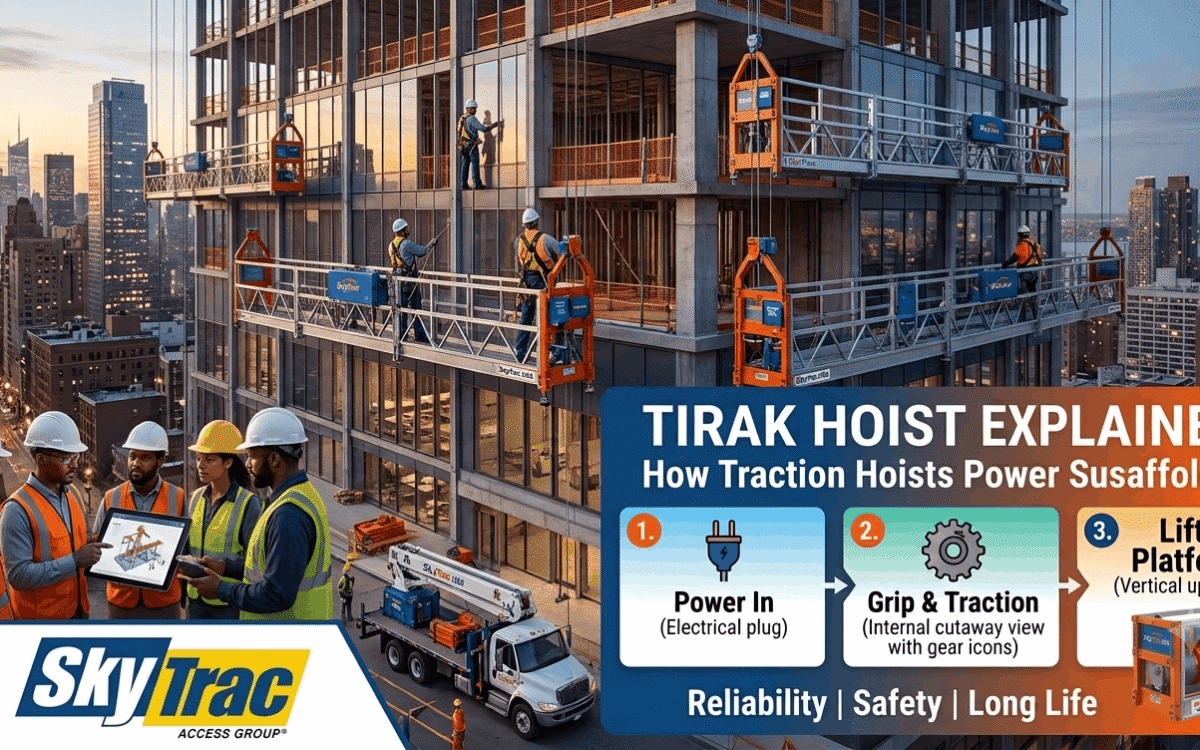
Walk past almost any building with a swing stage hanging off the roof and there is a good chance the motors on each end are Tiraks. On site the name gets used the way people say “Hoover” for a vacuum. You will hear it spelled tirack, called a tirak motor, or just “the tiraks.” But what actually is a Tirak hoist, and why is it the go-to for suspended scaffolding?
What is a Tirak hoist?
Tirak is Tractel’s line of traction hoists. A traction hoist does not wind wire rope onto a drum the way a winch does. Instead, the rope is fixed at the top of the building and runs through the hoist, and the hoist climbs up or down the rope, carrying the platform with it.
That difference matters. Because the hoist never stores the rope, there is no limit on lifting height other than the length of rope you hang. The same hoist can work a three-story walk-up or a high-rise.
How a traction hoist works
Think of it as a rope-climbing machine with several layers of safety built in.
- The rope goes in. The wire rope enters the top of the hoist from the roof.
- The drive grips it. Inside, the Tirak X-series uses a single-disk driver with spring-loaded pressure rollers that press the rope against a pulley. That grip is what lets the hoist pull itself along the rope.
- The motor turns the drive. As the motor runs, the pulley turns and the hoist moves up or down the rope. The slack rope exits out the bottom and hangs below the platform.
- The brake holds the load. An electromagnetic motor brake locks on automatically whenever the motor stops or the power cuts out.
The safety features that matter
Tirak hoists are built for man-riding work, so the safety systems are the part worth understanding.
- Blocstop secondary device: a separate safety device that runs on its own safety rope and locks on if the platform drops too fast or the main rope goes slack.
- Manual descent: a way to lower the platform in a controlled way during a power failure, so the crew is not stuck at height.
- Electromagnetic brake: holds the platform whenever the hoist is not being driven.
- Overload detection: available as an option on some models, it stops the hoist from lifting more than it is rated for.
Tirak hoists also meet CSA and UL requirements, which is one reason they are so common on North American job sites.
A closer look at the Tirak XE series
The XE series is the electric version of the X-series range, and it covers a working load range of about 700 to 4,400 lbs depending on the model. For typical two-point swing stages, the most common models are rated at 1,000 to 1,500 lbs. For example, the XE500P+ and XE501P+ lift 1,000 lbs at about 35 feet per minute on 5/16-inch wire rope.
If you are renting for a facade job in New York, a Tirak XE series hoist from SkyTrac comes in 1,000, 1,200 and 1,500 lb versions, in both three-phase and single-phase power. Where electricity is not available or not allowed, there is also an air-powered version, the XA series.
What to check before you ride
- The wire rope is the exact diameter and type the hoist is rated for, and it has no kinks, broken wires or crushing.
- The suspension point, whether an outrigger beam or cornice hook, is tied back to a solid anchor.
- The power supply matches the hoist’s voltage, and cables are in good condition.
- The brake, blocstop and emergency stop work when tested with the platform just off the ground.
- Every worker on the platform wears a full-body harness tied to an independent lifeline, not to the stage.
The hoist is only one part of the rig. What it hangs from matters just as much, which is why we wrote a separate guide on how outrigger beams support the rig.
Where to find the Tirak hoist manual
The manual is the best source for model-specific details such as rope specs, wiring, load ratings and the correct steps for manual descent. It is also worth keeping on site. You can download the full operating manual for the Tirak XE series as a PDF.
Final thoughts
A Tirak is a simple idea done very well: a hoist that climbs a rope instead of winding it. That is why it can work at almost any height. Understanding how it grips, brakes and protects the crew makes you a safer operator and a smarter renter.
SkyTrac Access Group (Sky Trac) in Woodside, Queens rents and sells Tirak hoists and is an authorized service center for Tractel and other major hoist brands. For a wider look at the parts that make up a full swing stage setup, see our list of essential suspended scaffold components.