If you have ever stood under a run of structural steel and wondered how to get a heavy load from the delivery truck to the third floor, you have already met the question this guide answers. Do you need an I-beam trolley, a beam hoist, or both?
The short answer is that most job sites need both, working together. But knowing what each piece does, and where its job stops, saves money, time and a few close calls. Here is how to think it through.
What is an I-beam trolley?
An I-beam trolley is a wheeled carriage that clamps around the bottom flange of a steel I-beam. Its job is to move along the beam. On its own it does not lift anything. What it gives you is a moving hang point, so a load can travel sideways along the length of the beam.
Trolleys come in three main types. Plain or push trolleys are moved by hand by pushing the load. Geared trolleys use a hand chain to drive the wheels, which gives better control with heavier loads. Motorized trolleys run on power and suit long runs or repetitive moves. You will also hear them called steel beam trolleys or simply beam trolleys.
What is a beam hoist?
A beam hoist does the actual lifting. It hangs from the beam, either from a fixed point or from a trolley, and raises and lowers the load with chain or wire rope. Hoists can be manual, electric or air-powered.
Mount a hoist to a beam with a fixed top and it lifts in one spot only. Pair it with a trolley and you have what is usually called a beam trolley hoist or an I-beam hoist system: vertical lifting plus horizontal travel.
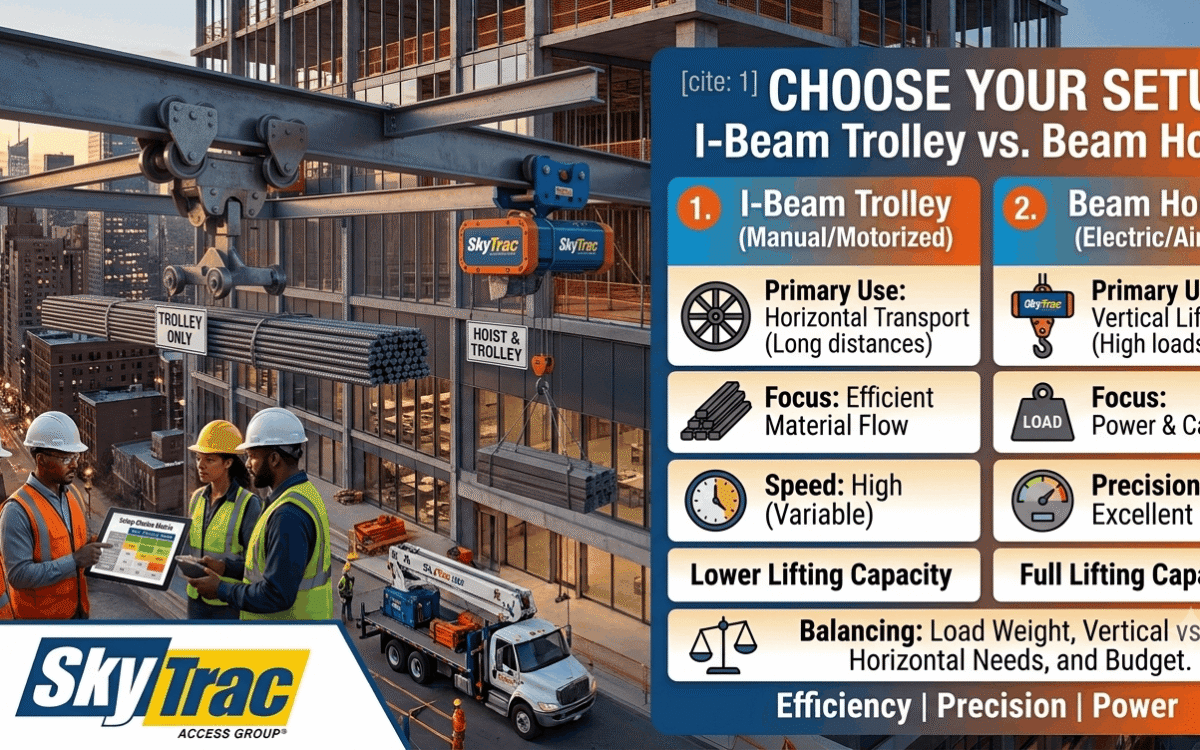
Trolley vs. hoist at a glance
| I-beam trolley | Beam hoist | |
| What it does | Moves the load along the beam | Raises and lowers the load |
| Works on its own? | No, it needs a hoist or hook below it | Yes, from a fixed beam mount |
| Power options | Push, geared or motorized | Manual, electric or air |
| Best for | Landing loads at different points along a run | Straight vertical lifts at one point |
How to choose the right setup
- Start with the load. Work out the heaviest load you will lift, including slings and rigging. Every part of the system, from the beam and mount to the trolley and hoist, must be rated for it. The lowest rating in the chain is your real limit.
- Measure the beam flange. Trolleys are built for a range of flange widths. Measure the bottom flange and check that the trolley adjusts to it. A trolley that does not fit properly can twist or come off the beam.
- Decide whether the load needs to travel. If materials only go straight up, for example through a floor opening, a fixed mount is simpler and cheaper. If you need to set loads down at different points, add a trolley.
- Pick the power source. A manual hoist is fine for occasional, light lifts. Electric makes sense for frequent or tall lifts. Air-powered units suit sites where electricity is not available or not safe to use.
- Think about lift height and how often you lift. If you are making long lifts many times a day, a powered hoist with unlimited rope length will save hours.
Mounting: where many setups go wrong
A hoist is only as safe as the thing it hangs from. Before choosing a trolley, check that your I-beam mounting brackets are rated for the load you plan to lift.
SkyTrac’s I-beam mounts are a good example of how flexible this can be. A rolling I-beam trolley top lets many Beta Max hoists run along existing I-beams. A fixed I-beam top holds the hoist in place when you do not need sideways travel. And I-beam suspension brackets let you hang a beam from scaffold frames when there is no suitable steel to use.
If the materials you are moving are lighter and you need something you can carry to the roof, a compact electric hoist may suit you better. Our guide to portable material hoists compares two popular models.
Safety checklist before every lift
- Confirm the rated capacity of the beam, mount, trolley and hoist, and work to the lowest one.
- Make sure end stops are fitted on both ends of the beam so the trolley cannot run off.
- Inspect the beam for bends, damage or corrosion, and check wheels, hooks, chain or wire rope.
- Test the brake and limit switches with no load before the first lift of the day.
- Keep everyone out from under the load, and never ride a material hoist.
- Follow the manufacturer’s manual and local rules. In New York City, some rigging work must be done by or under a licensed rigger.
The bottom line
A trolley moves and a hoist lifts. If your loads only go up and down in one place, a hoist on a fixed beam mount is enough. If they need to travel along the beam, pair the hoist with a trolley. Either way, get the mount right first.
If you want help sizing a setup, SkyTrac Access Group (often searched as Sky Trac) rents and sells material hoists, I-beam mounts and the hardware that goes with them across the New York area. To see how these pieces fit into a full access setup, read our roundup of key suspended scaffold components.