If you have ever managed a complex construction project in New York City, you already know that getting heavy materials up into the air is only half of the logistical battle. Suppose you have successfully utilized a motorized hoist to lift a 1,000-pound pallet of mortar or a massive architectural glass panel 30 stories up the side of a building. Now comes the truly difficult part: how do you pull that heavy, suspended load horizontally to get it safely onto the floor slab or into the building envelope?
You cannot simply push a 1,000-pound swinging load by hand, and a tower crane cannot maneuver materials deep into an elevator shaft or under a structural canopy. To safely achieve lateral, horizontal movement on an elevated job site, smart rigging professionals utilize the building’s own steel skeleton.
By combining a lifting motor with a specialized tracking carriage, your crew can move massive loads horizontally with a single hand. Here is an educational look at the specific equipment required to safely glide heavy materials along overhead steel.
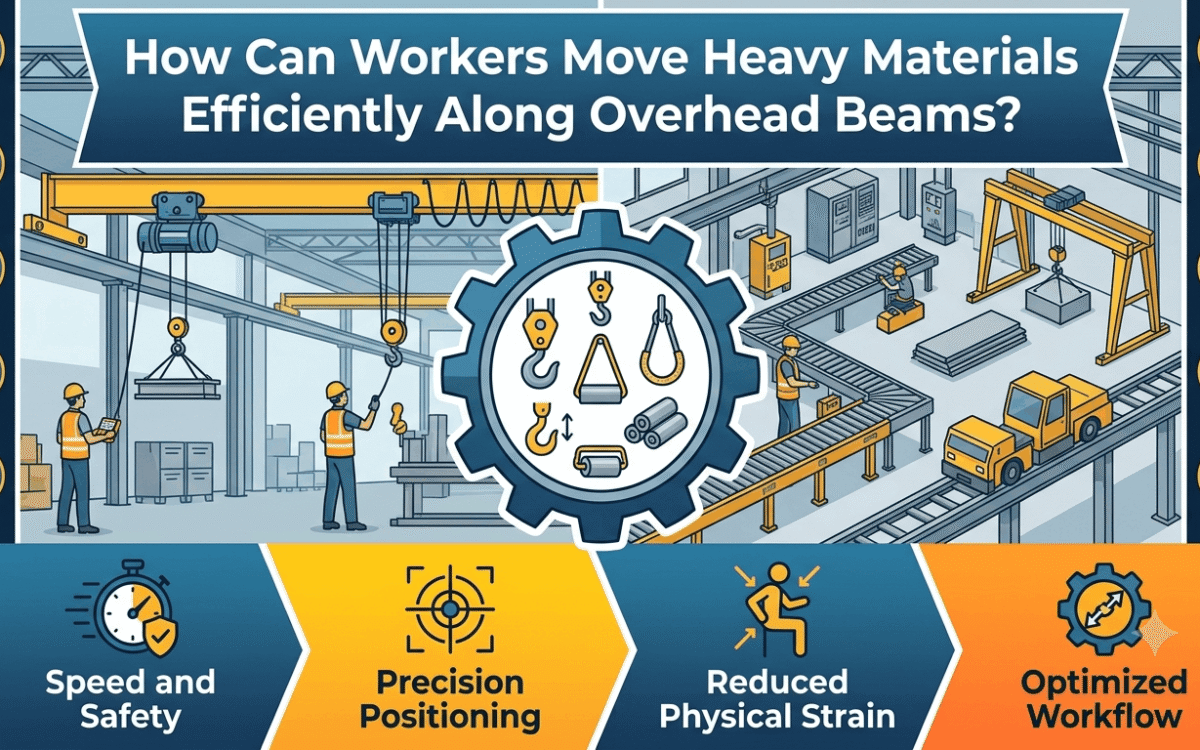
How do workers move heavy materials along overhead beams?
To safely and efficiently move heavy loads horizontally across a job site, construction crews utilize an I beam trolley.
The Mechanism: This is a heavy-duty, wheeled steel carriage that clamps securely around the bottom flange of an exposed structural I-beam.
The Function: It provides a rolling anchor point. Workers hang their material hoist (such as a Minifor motor or chain block) directly from the trolley.
The Result: Once the load is lifted vertically by the hoist, the trolley’s heavy-duty ball-bearing wheels allow the operator to smoothly roll the suspended load horizontally along the beam to its final destination.
Here is a closer look at how this equipment transforms urban material handling and how to choose the right variation for your specific project.
1. The Flaw of Static Rigging
In traditional rigging setups, contractors often use static mounting brackets to hang their material hoists. While a static bracket provides an incredibly secure, immovable anchor point for vertical lifting, it completely traps the load in one location.
If your crew is installing heavy HVAC equipment across a wide mechanical floor, or replacing a long row of heavy glass panels inside a commercial atrium, a static anchor forces them to repeatedly dismantle the lifting station and rebuild it a few feet away. This repetitive teardown destroys your job site efficiency. By introducing an I beam trolley to the workflow, the lifting station becomes mobile. The structural steel beam essentially transforms into a custom monorail system, allowing continuous horizontal workflow without ever unhooking the load.
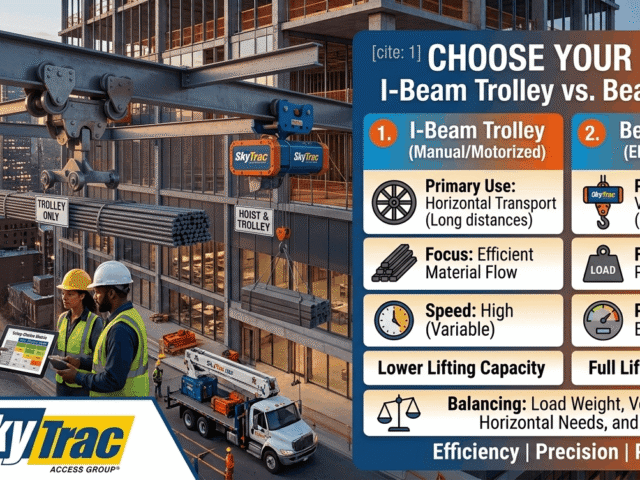
2. Push Trolleys vs. Geared Trolleys
Not all horizontal loads are created equal. Depending on the weight of the material your crew is moving, you will need to select between the two primary types of trolleys:
- Push Trolleys (Manual): These are the most common units used for light to medium-duty loads (typically under 1 or 2 tons). The carriage features free-rolling, sealed ball-bearing wheels. Once the load is hoisted into the air, the worker simply pushes the suspended load by hand. The highly efficient wheels allow heavy loads to glide effortlessly along the beam with minimal physical strain.
- Geared Trolleys (Mechanical): If you are moving extreme weights such as multi-ton steel girders or massive industrial generators pushing the load by hand becomes dangerous or physically impossible. A geared trolley features a continuous hand chain that hangs down to the operator. By pulling the hand chain, the operator engages a set of gears that physically drive the trolley wheels forward or backward, offering millimeter-precise control over massive weights.
3. Engineering and Safety Compliance
While gliding a heavy load along an overhead beam sounds simple, it requires intense mechanical scrutiny. In a highly regulated environment like New York City, the Department of Buildings (DOB) and OSHA strictly monitor material handling setups.
You cannot attach a rolling carriage to just any piece of metal. Before the equipment is installed, a Licensed Special Rigger or structural engineer must verify that the specific I-beam can handle the dynamic, rolling weight of the load without twisting or deflecting. Furthermore, the trolley must be meticulously adjusted using spacing washers to ensure the wheels fit the beam’s exact flange width. If the trolley is improperly adjusted, it can physically slip off the beam mid-transit, resulting in a catastrophic job site failure.
Streamline Your Material Handling with SkyTrac
Moving heavy materials through the dense, complicated architecture of a New York City job site is a high-stakes engineering challenge. You cannot afford to rely on guesswork or generic equipment when your crew’s safety and your project’s timeline are on the line.
To maximize your lateral material handling, you need a specialized vertical access partner. SkyTrac Access Group, operating from our state-of-the-art logistics hub in Woodside, NY, is the region’s premier authority on code-compliant rigging and hoisting.
We do far more than just supply the industry’s most durable I beam trolley systems and pass-through hoists. Our in-house team of structural engineers and Licensed Special Riggers will evaluate your building’s specific structural steel, design a flawless material handling strategy, and ensure every component meets strict DOB safety multipliers.
Ready to safely maximize your job site efficiency? Contact the rigging and access experts at SkyTrac today.
- Office Line: 718-590-7000
- Logistics Hub: Woodside, NY
- Digital Portal: skytracusa.com